
Sapphire FUE vs. DHI (Direct Hair Implantation): The Future of High-Density Hair Transplants
“The traditional surgical scalpel is obsolete; in 2026, aesthetic mastery is defined by the micro-precision of a Sapphire blade and the absolute control of a Choi implanter pen.”
The landscape of hair restoration has undergone a massive technological renaissance. Patients in 2026 are highly educated; they are no longer walking into clinics simply asking for a “hair transplant.” They are actively researching premium modalities, comparing the recovery times, density outputs, and surgical tools used by top-tier professionals. To capture this bottom-of-the-funnel, high-intent audience, an aesthetic practice must move beyond standard Follicular Unit Extraction (FUE) and offer the absolute pinnacle of surgical innovation: Sapphire FUE and Direct Hair Implantation (DHI).
For medical professionals looking to upgrade their clinics, understanding the nuanced differences between these two advanced techniques is the key to delivering flawless, undetectable results. Both methods eliminate the linear scarring associated with the outdated FUT (strip) method, but they diverge significantly in their surgical execution and ideal patient profiles.
Here is a comprehensive clinical deep-dive into Sapphire FUE and DHI, designed to elevate your medical expertise and help your patients make informed, premium choices.
Understanding Sapphire FUE: The Power of the Gemstone
Standard FUE involves extracting hair follicles using a micro-motor and then opening channels in the recipient area using steel blades. Sapphire FUE revolutionizes this second step by replacing steel with blades crafted from pure synthetic sapphire.
Why does a gemstone make such a profound clinical difference?
- V-Shaped Incisions: Steel blades create U-shaped slits, which can cause micro-trauma and leave slight gaps around the implanted follicle. Sapphire blades create incredibly sharp, precise V-shaped incisions. This ensures the follicle fits perfectly into the channel, reducing the risk of graft displacement.
- Maximum Density: Because the Sapphire blade is drastically sharper and smoother than steel, surgeons can open micro-channels much closer together without compromising tissue integrity. This allows for an exceptionally high-density transplant, packing more grafts per square centimeter.
- Accelerated Healing: Sapphire is highly antimicrobial and minimizes vibration during the incision process. This translates to significantly less tissue damage, reduced scabbing, minimal edema (swelling), and a remarkably faster postoperative recovery for the patient.
Understanding DHI (Direct Hair Implantation): Absolute Angulation Control
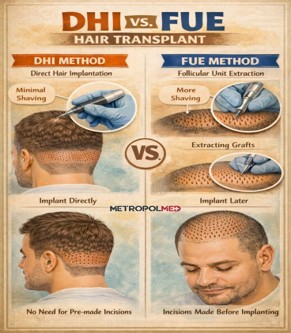
If Sapphire FUE is about perfecting the channel, Direct Hair Implantation (DHI) is about eliminating the channel-creation step entirely. DHI utilizes a specialized, spring-loaded surgical instrument known as the Choi Implanter Pen.
In this technique, the extracted hair follicle is meticulously loaded into the hollow needle of the Choi pen. The surgeon then directly implants the follicle into the scalp in a single, fluid motion. There is no prior creation of recipient slits.
The clinical advantages of DHI are unparalleled for specific cases:
- Ultimate Directional Control: The Choi pen gives the surgeon 360-degree control over the depth, angle, and direction of every single hair. This is crucial when recreating a natural hairline or working within the intricate whorl of the crown.
- Reduced “Out of Body” Time: Because the follicles are implanted almost immediately after extraction, their time outside the body is drastically minimized. This maximizes graft survival rates.
- The “Unshaven” Transplant: DHI is the gold standard for patients who refuse to shave their recipient area. The pen allows the surgeon to navigate between existing, long native hairs without damaging them, making it the perfect solution for female patients or high-profile professionals requiring absolute discretion.
Sapphire FUE vs. DHI: A Clinical Comparison for Your Practice
When a patient asks, “Which is better?”, the clinical consensus is that neither is universally superior; they are specialized tools meant for different anatomical challenges. Knowing which technique to deploy is what separates a technician from a master surgeon.
- Coverage Area and Graft Volume:
- Sapphire FUE is the definitive choice for patients suffering from extensive hair loss (Norwood Stages 4-7). Because the surgeon can open thousands of channels rapidly, it is possible to successfully transplant 3,000 to 4,500+ grafts in a single mega-session.
- DHI is a highly meticulous, labor-intensive process. Loading and deploying the Choi pens takes time. Therefore, DHI is typically capped at around 2,000 to 2,500 grafts per session. It is ideal for smaller areas, hairline lowering, or adding density to thinning areas.
- Density and Precision:
Both methods offer exceptional density. However, DHI excels in “density-packing” between existing terminal hairs without causing shock loss to the native follicles. Sapphire FUE is unparalleled when building a high-density result on a completely bald recipient site.
- Surgical Time and Premium Pricing:
From a business perspective, DHI commands a higher premium. It requires a larger medical team (typically two technicians simultaneously loading the Choi pens for the surgeon) and takes longer to perform. Integrating DHI into your clinic allows you to capture the ultra-premium market segment willing to pay for unshaven, minimally invasive procedures.
To help you and your patients visualize the ideal surgical path based on their specific graft requirements, explore the interactive clinical decision tool below:
Multimedia Integration: Enhancing Patient Trust
To truly dominate local search rankings and increase page dwell time (a massive SEO ranking factor), top clinics integrate rich multimedia. We highly recommend embedding educational content directly into your patient portals. For a visual demonstration of how the Choi pen compares to standard incision methods, watch this comprehensive surgical breakdown.
The IICAD Masterclass: Elevating Your Surgical Repertoire
The aesthetic market in 2026 does not tolerate outdated techniques. If you are a doctor operating in highly competitive, affluent markets, your clinical repertoire must include both Sapphire FUE and DHI. Attempting to learn the tactile pressure required for a Choi pen or the angulation of a Sapphire blade through observation alone is a significant clinical risk.
At the International Institute of Cosmetology, Aesthetics & Dentistry (IICAD), we ensure our doctors are trained on the absolute bleeding edge of surgical technology. Our curriculum dives deep into the physics, biology, and hands-on execution of both Sapphire and DHI methodologies on live patients.
We don’t just teach you how to transplant hair; we teach you how to design masterpieces that command premium pricing, ensuring the highest clinical outcomes and business ROI for your practice.
Ready to future-proof your aesthetic practice? Explore our advanced curriculum and secure your seat in the Masterclass in Hair Transplant in Bangalore.
Contact Our Bangalore Institute for Admissions:
- International Institute of Cosmetology, Aesthetics & Dentistry
- Address: Bus Stop, 212, 2nd floor, 4th Main Rd, opposite ESI dispensary, near VivekNagar, P.O, Vivek Nagar, Karnataka 560047
- Phone: 06364636662