
Mastering PRP Therapy for Hair Loss: The Definitive Clinical and Business Guide
“Liquid gold: Why PRP is the most versatile tool in your aesthetic arsenal.”
The modern aesthetic and dermatological landscape is experiencing a profound shift. Patients are increasingly moving away from synthetic pharmacological treatments and invasive surgeries as their first resort, actively seeking out regenerative, autologous therapies. They want solutions that utilize their body’s own healing mechanisms to restore youth, vitality, and confidence. In the realm of trichology and hair restoration, nothing embodies this shift quite like Platelet-Rich Plasma (PRP) therapy.
Often referred to in the medical aesthetic community as “liquid gold,” PRP has rapidly evolved from a niche experimental treatment to a globally recognized, baseline standard of care for androgenetic alopecia and telogen effluvium. For practitioners looking to build a resilient, high-growth clinical practice, mastering the biological science, the precise injection protocols, and the business analytics of PRP is an absolute necessity.
The Biological Blueprint: How Liquid Gold Reverses Hair Loss
To confidently offer PRP in your practice, you must first possess a deep, articulate understanding of its mechanism of action. When a patient sits in your consultation chair, they are not just buying a procedure; they are investing in your medical authority.
Androgenetic alopecia is characterized by the progressive miniaturization of hair follicles. Driven by genetic and hormonal factors (specifically dihydrotestosterone, or DHT), the active growth phase (anagen) of the hair cycle shortens, while the resting and shedding phases (catagen and telogen) lengthen. Over time, terminal hairs shrink into fine, unpigmented vellus hairs.
PRP acts as a powerful biological intervention to this miniaturization process. By drawing a small volume of the patient’s own blood and spinning it in a centrifuge, practitioners isolate a concentrated suspension of platelets. These platelets are densely packed with alpha granules that, upon activation in the scalp, release a massive payload of critical growth factors:
- Vascular Endothelial Growth Factor (VEGF): Triggers angiogenesis, building new microscopic blood vessels around the dermal papilla to drastically increase the flow of oxygen and targeted nutrients to the starving follicle.
- Platelet-Derived Growth Factor (PDGF): Stimulates the rapid proliferation of dermal fibroblasts, reinforcing the structural matrix of the scalp tissue.
- Epidermal Growth Factor (EGF): Promotes cell growth and differentiation, signaling dormant follicles to re-enter the active anagen phase.
By bathing the follicular bulge—the area rich in stem cells—in these concentrated growth factors, PRP effectively wakes up dormant hair follicles, increases the diameter of the hair shaft, and drastically extends the survival of the hair cycle.
Clinical Consensus: Building Trust Through Peer-Reviewed Authority
In the age of hyper-informed patients, clinical claims must be substantiated by rigorous scientific consensus. Integrating peer-reviewed research into your patient education and digital marketing assets is one of the most effective ways to establish unbreakable trust and authority.
The efficacy of PRP is not anecdotal; it is backed by world-renowned medical institutions. A prime example is the extensive research and clinical reporting from the Mayo Clinic. In their detailed clinical discussions, such as the widely referenced Science Saturday: Platelet-rich plasma found to be effective in regrowing hair, the consensus is clear: PRP is a scientifically validated, effective treatment modality for stimulating hair regrowth.
Because PRP utilizes the patient’s own blood, it boasts a superior safety profile, entirely eliminating the risks of cross-contamination, allergic reactions, or immune rejection. Referencing authoritative sources like the Mayo Clinic in your clinic’s literature not only reassures anxious patients but also signals to search engines that your practice aligns with verified, high-quality medical data.
The Clinical Protocol: Precision in Execution
Acquiring a centrifuge is simple; executing a flawless, low-pain, high-yield PRP session requires master-level technique. The efficacy of the treatment is highly dependent on the practitioner’s protocol.
- Phlebotomy and Centrifugation: The process begins with drawing 15 to 20 cc of whole blood. The speed and duration of the centrifuge cycle are critical. The goal is to achieve a platelet concentration that is ideally 4 to 6 times the patient’s baseline. A double-spin method is often taught in advanced courses to ensure maximum platelet recovery while completely isolating the red and white blood cells, which can cause unnecessary inflammation.
- Activation: Before injection, the PRP is often activated using a calcium chloride or calcium gluconate solution. This triggers the degranulation of the platelets, initiating the immediate release of growth factors just as the plasma enters the scalp.
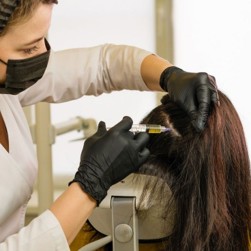
- Depth-Controlled Injection (Nappage Technique): This is where artistry meets anatomy. Using a fine 30-G or 32-G needle, the physician must inject the PRP precisely into the dermal layer, targeting a depth of 1.5 mm to 2.5 mm. Injecting too superficially wastes the liquid gold in the epidermis; injecting too deeply loses it in the subcutaneous fat. Precise depth perception ensures the growth factors directly saturate the hair bulge and dermal papilla.
Practice Economics: The Analytics of Recurring Revenue
From a clinical management and business analytics perspective, integrating PRP represents one of the highest Return on Investment (ROI) decisions a medical professional can make.
Unlike a one-off surgical hair transplant, PRP therapy relies on a structured, recurring protocol. A standard treatment plan typically involves an induction phase of three to four sessions spaced four weeks apart, followed by bi-annual maintenance sessions. This structure inherently maximizes Customer Lifetime Value (CLV).
When digital marketing campaigns are optimized to capture leads searching for “hair loss solutions,” converting a patient for a PRP consultation establishes a long-term, multi-year clinical relationship. Because the consumables (tubes, needles, local anesthesia) are relatively inexpensive compared to the high perceived value of the treatment, the profit margins are exceptionally strong. This predictable, recurring revenue stream creates immense financial stability for the clinic, dramatically improving the overall Return on Ad Spend (ROAS).
Elevate Your Clinical Authority with IICAD
Understanding the underlying science of cellular regeneration is the foundation; executing the procedure with flawless tactile precision is the standard of mastery. The variance in human scalp anatomy and the technical nuances of centrifugation require rigorous, hands-on clinical education.
At the International Institute of Cosmetology, Aesthetics & Dentistry (IICAD), our specialized curriculum is meticulously designed for ambitious doctors who want to master the full spectrum of hair restoration. We bridge the gap between theoretical science and highly profitable, real-world clinical application. By training on live patients under the direct supervision of veteran specialists, you will develop the critical muscle memory and diagnostic acumen required to run a top-tier aesthetic center.
Step into the future of regenerative medicine and transform your medical practice. Explore our comprehensive, evidence-based curriculum and secure your admission today by visiting the Masterclass in Hair Transplant in Bangalore.
Contact Our Bangalore Campus for Admissions and Information:
- International Institute of Cosmetology, Aesthetics & Dentistry
- Address: Bus Stop, 212, 2nd floor, 4th Main Rd, opposite ESI dispensary, near VivekNagar, P.O, Vivek Nagar, Karnataka 560047
- Phone: 06364636662