
Latest Technologies and Protocols in Dental Implants
“Titanium and tech: The evolution of the dental implant in the digital age.”
The field of implantology has moved far beyond the simple replacement of missing teeth. In 2026, we have entered an era of “biological precision,” where digital workflows and advanced material sciences have turned a once-unpredictable surgery into one of the most successful medical procedures available.
According to authoritative medical consensus, such as guidelines provided by the Mayo Clinic, dental implant surgery effectively replaces tooth roots with metal, screw-like posts. This provides a level of stability that dentures or bridgework simply cannot match. However, the true “magic” of a modern implant lies in osseointegration—the physiological process where bone heals tightly around the titanium surface.
For the modern practitioner, staying relevant means mastering the transition from analog “freehand” surgery to a fully integrated digital ecosystem. Here is a deep dive into the technologies and protocols defining the high-tech dental practice of today.
- The Digital Diagnostic Foundation: CBCT and Intraoral Scanning
The first step in modern protocols is no longer a physical impression. It is the creation of a “Digital Twin” of the patient’s oral cavity.
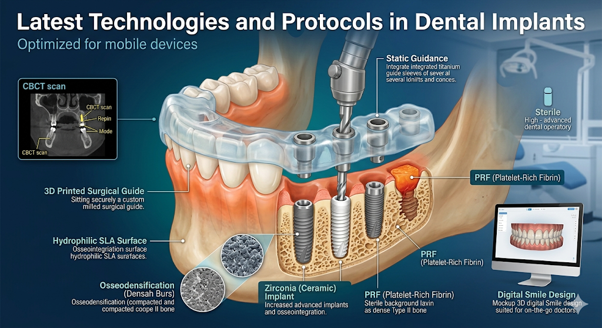
Cone Beam Computed Tomography (CBCT) has become the non-negotiable standard. Unlike traditional X-rays, CBCT provides a 3-D view of the jawbone, nerves, and sinus cavities. This allows doctors to assess the jawbone’s condition—a critical step highlighted by the Mayo Clinic—before the first incision is made.
When combined with Intraoral Scanners, which capture the precise topography of the soft tissue and dentition, surgeons can perform “virtual surgery.” This digital synergy ensures that the implant is placed in the ideal position for both surgical safety and final prosthetic aesthetics.
- Guided Surgery: From Static to Dynamic Navigation
The “blind” era of implantology is over. Today, protocols prioritize Guided Surgery to minimize human error and surgical morbidity.
- Static Guidance: Static guidance transforms a virtual dental implant plan into physical reality using CAD/CAM technology. The process begins by merging a patient’s 3D CBCT scan (showing bone depth) with an intraoral scan (showing the surface of gums and teeth). Using this combined data, a customized, rigid resin template is 3D-printed to fit perfectly and securely over the patient’s dental arch.
- The defining feature of a static guide is its use of titanium “sleeves.” Embedded directly into the printed resin, these small metal cylinders act as rigid, unyielding tracks for the surgical drill. Unlike freehand surgery, where the dentist relies on visual estimation, the sleeves mechanically restrict the drill’s movement. They physically dictate the exact trajectory, angulation, and maximum depth of the drill bit, ensuring the implant is placed exactly where the software planned it. Because the guide prevents deviation, it minimizes the risk of catastrophic errors, such as damaging nerves, perforating the sinus floor, or hitting adjacent roots. Furthermore, static guidance often enables “flapless” surgery—meaning no scalpels or sutures are needed—resulting in drastically reduced postoperative swelling, minimal pain, and a perfectly positioned prosthetic foundation.
- Dynamic Navigation (Robotic-Assisted): The cutting edge of 2026 involves GPS-like tracking systems. Sensors on the handpiece and the patient allow the surgeon to see the drill’s position inside the bone on a screen in real-time. This allows for “flapless” surgery, leading to significantly less pain and faster healing.
- Surface Science: Enhancing Osseointegration
While titanium remains the gold standard due to its biocompatibility, the surface of the titanium has evolved.
Modern implants utilize SLA (Sand-blasted, Large-grit, Acid-etched) surfaces or hydrophilic coatings. These microscopic textures increase the surface area for bone cells to latch onto.
Furthermore, Zirconia Implants (ceramic) are gaining popularity for patients with thin gingival biotypes or metal sensitivities. These provide superior “pink aesthetics,” as there is no dark metal shadow visible through the gums.
- Accelerated Protocols: Immediate Loading
One of the most frequent questions from patients is: “How long until I get my tooth?” While the Mayo Clinic correctly notes that traditional bone healing can take many months, Immediate Loading protocols are changing the timeline.
By achieving high Primary Stability—measuring the mechanical “tightness” of the implant using Resonance Frequency Analysis (RFA)—surgeons can often attach a temporary crown on the same day as the surgery. This “Teeth in a Day” protocol relies on the 3D digital plan created pre-operatively, ensuring the forces on the new implant are balanced perfectly to avoid disrupting the healing bone.
- Bone Grafting and Sinus Lifts in the 3D Era
A major barrier to implants is a lack of natural tooth roots or bone volume. In the past, a lack of bone meant a patient was “not a candidate.”
Today, Piezoelectric Surgery (using ultrasonic vibrations instead of saws) allows for incredibly precise bone harvesting and sinus lifts with minimal risk to soft tissues or nerves. Additionally, the use of PRF (Platelet-Rich Fibrin)—derived from the patient’s own blood—is now a standard protocol to accelerate bone regeneration and soft tissue closure.
To understand the clinical efficiency and patient outcomes associated with these technological upgrades, explore the tool below:
The IICAD Advantage: Why Modern Training is Essential
The technology is only as effective as the doctor wielding it. A “millimeter of error” in the digital age is still an error. This is why practitioners are moving away from short-term certificate courses toward comprehensive, fellowship-level training.
At the International Institute of Cosmetology, Aesthetics & Dentistry (IICAD), we focus on the entire digital ecosystem. From mastering CBCT interpretation to performing live-patient guided surgeries, our curriculum ensures you aren’t just using technology—you are mastering it.
The aesthetic and surgical standards of 2026 demand a fusion of biology and technology. If you are ready to transition from a general practitioner to a surgical expert, our specialized diplomas provide the bedrock you need.
Master the future of implantology. Explore our PG Diploma in Aesthetic Dentistry and specialized implant modules today.
Step 1: Contact and Location Details
Bangalore
- International Institute of Cosmetology, Aesthetics & Dentistry
- Address: Bus Stop, 212, 2nd floor, 4th Main Rd, opposite ESI dispensary, near VivekNagar, P.O, Vivek Nagar, Karnataka 560047
- Phone: 06364636662